
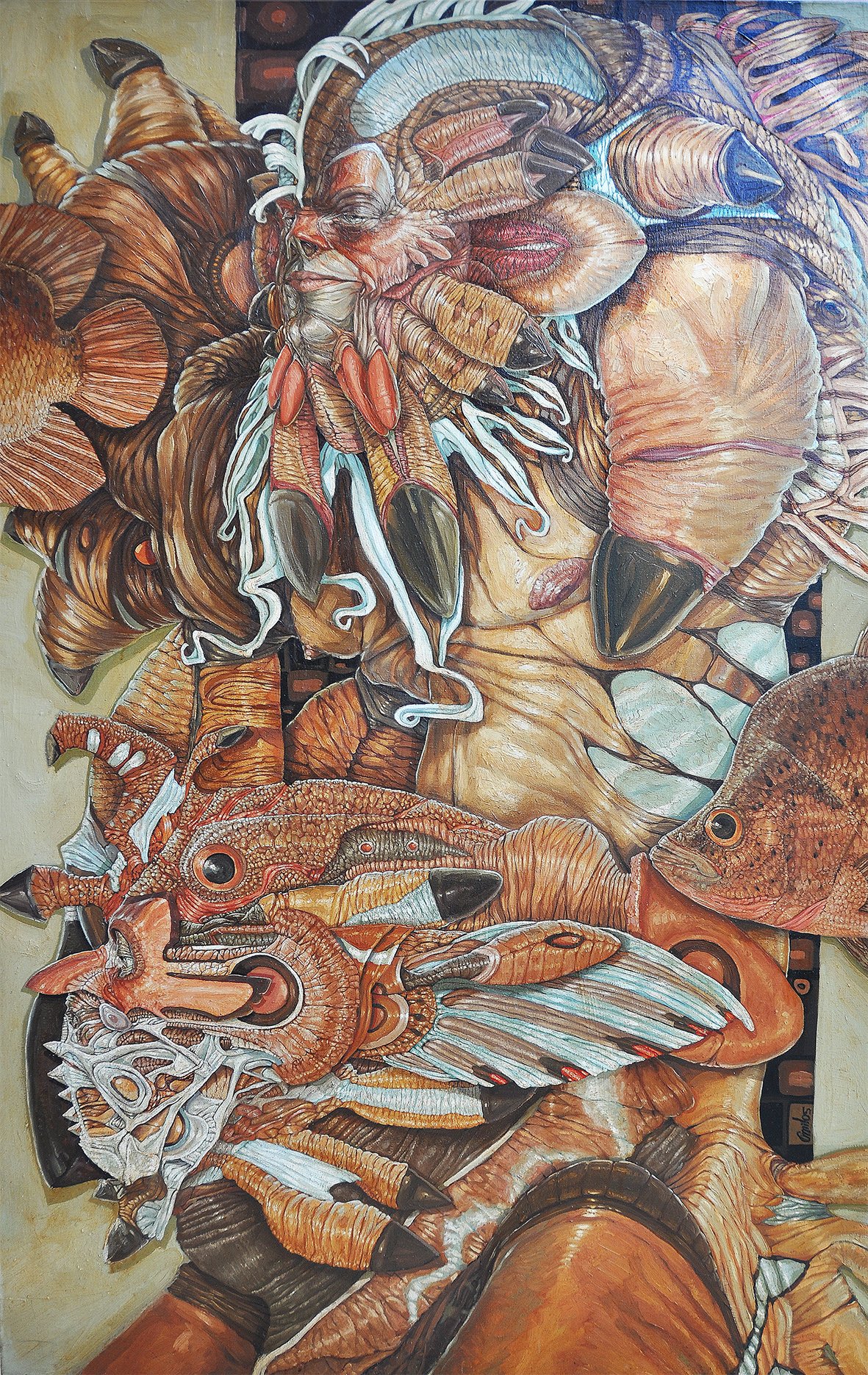
Dycon II
2004
Oil and resin on canvas
62.40 × 38.19 in (158.5 × 97 cm)
Status: Private Collection
Collection: Yctyogenesis
Dycon II presents one of the most architecturally complex organisms in Yctyogenesis—an entity built around layered protection and adaptive camouflage. Its body is composed of overlapping plates, chitinous ridges, and horn-like extensions that resemble both deep-sea armor and terrestrial carapaces. The creature’s anatomical clusters interlock like a living fortress, creating a form that is simultaneously impenetrable and highly engineered.
Unlike the assertive, fortified presence implied in Dycon I, this being embodies survival through concealment. Its textures echo sediments, coral, and stratified marine rock, suggesting a species that blends seamlessly into its environment until movement becomes necessary. Every structural segment appears evolved to break outlines, scatter light, and confuse predators.
Dycon II is a testament to camouflage as an evolutionary strategy—an organism that survives not by dominance, but by vanishing into the terrain that shaped it.